Basic Input/Output
We played some optimization tennis with the WASD code, its was stupid.
I still don't know what I'm doing with this repo, maybe I should just make a game about unfinished game projects ... "The minds of Indie Developers"
Regardless though I want some input and some result of that input to appear on screen. I mean that's 99% of the game done at that point isn't it?
So some typing later ...
/* Data Types */

struct transform {
        float position[3];
};

struct input_device {
        float move_axis[2];
};

struct time {
        float delta;
};

struct player {
        struct transform tform;
};

struct ground {
        struct transform tform;
};

struct game {
        /* Platform */
        struct input_device input_device;
        struct time time;
        /* World */
        struct player player;
        struct ground ground;
};

/* Game loopy functions */

void update_platform(struct game *game);
void update_player(struct game *game);
void update_render(struct game *game);
Now to hook some Raylib so we can get some input, my nice simple wasd controls
void
update_platform(
        struct game *game)
{
        /* Input Device
         */

        uint8_t kw = IsKeyDown(KEY_W);
        uint8_t ka = IsKeyDown(KEY_A);
        uint8_t ks = IsKeyDown(KEY_S);
        uint8_t kd = IsKeyDown(KEY_D);

        int8_t mx = kd - ka;
        int8_t my = kw - ks;
        uint8_t ml = (mx & my) & 1;

        /* 1 or (sqrt(2) / 2), we do this so that we dont move faster
         * when going diagonal, this is what you'd get if you
         * normalized the vector {1, 0, 1}, then asked for its
         * length.
         */
        float len_rcp = (float[2]) { 1.f, 0.70710678118f }[ml];

        float kb_x = mx * len_rcp;
        float kb_y = my * len_rcp;

        game->input_device = (struct input_device) {
                .move_axis = { kb_x, kb_y },
        };

        /* Timer
         */

        game->time = (struct time) {
                .delta = GetFrameTime(),
        };
}
Sooooo. maybe not as 'simple' as it could be, I should provide some context, some time ago a friend and myself were making a prototype game and for whatever reason we played some optimization tennis with the WASD code, its was stupid, it was fun. (Maybe not a surprise but we never started making the game, let alone finish the prototype).
We got rid of all the branches and the vector normalization code, in a weird way I actually think its a nice example of how to approach optimization, we went from logic to data. And we pushed vector normalization code back in time.
I do personally have a grudge with the seemingly default approach of endless fucking branches that folk seem to have, but that is a rant for another day.
We also need to store the accumulation of the input, with some time logic so it can handle any inconsistent frame times.
void
update_player(
        struct game *game)
{
        /* Update player based on input
         */

        float dt = game->time.delta;
        float sp = 10.f;
        float ds = dt * sp;

        game->player.tform.position[0] += ds * game->input_device.move_axis[0];
        game->player.tform.position[2] += ds * game->input_device.move_axis[1];
}
Woo! Now that we have all that, we can reach back into Raylib to render this.
void
update_render(
        struct game *game)
{
        BeginDrawing();
        ClearBackground(RAYWHITE);

        Camera3D camera = { 0 };
        camera.position = (Vector3){ 0.0f, 10.0f, 10.0f };
        camera.target = (Vector3){ 0.0f, 0.0f, 0.0f };
        camera.up = (Vector3){ 0.0f, 1.0f, 0.0f };
        camera.fovy = 45.0f;
        camera.projection = CAMERA_PERSPECTIVE;

        BeginMode3D(camera);

        Vector3 cubePosition = {
                game->player.tform.position[0],
                game->player.tform.position[1],
                game->player.tform.position[2]
        };
        DrawCube(cubePosition, 2.0f, 2.0f, 2.0f, RED);
        DrawCubeWires(cubePosition, 2.0f, 2.0f, 2.0f, MAROON);

        DrawGrid(10, 1.0f);

        EndMode3D();
        EndDrawing();
}
Yesh! (Said Sir Sean), it moves!
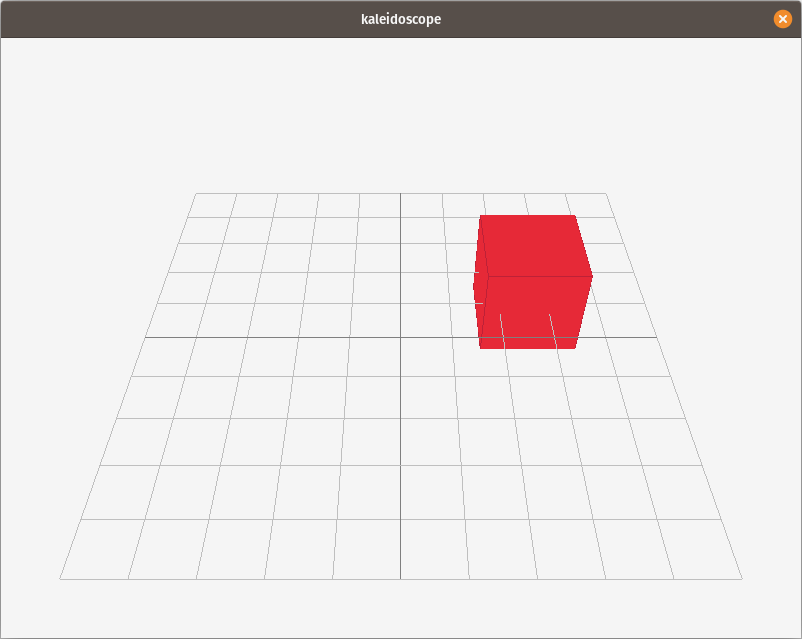
Early Access incoming.
Shoulda made a Gif then you'd see the sheer amazing level of gameplay.